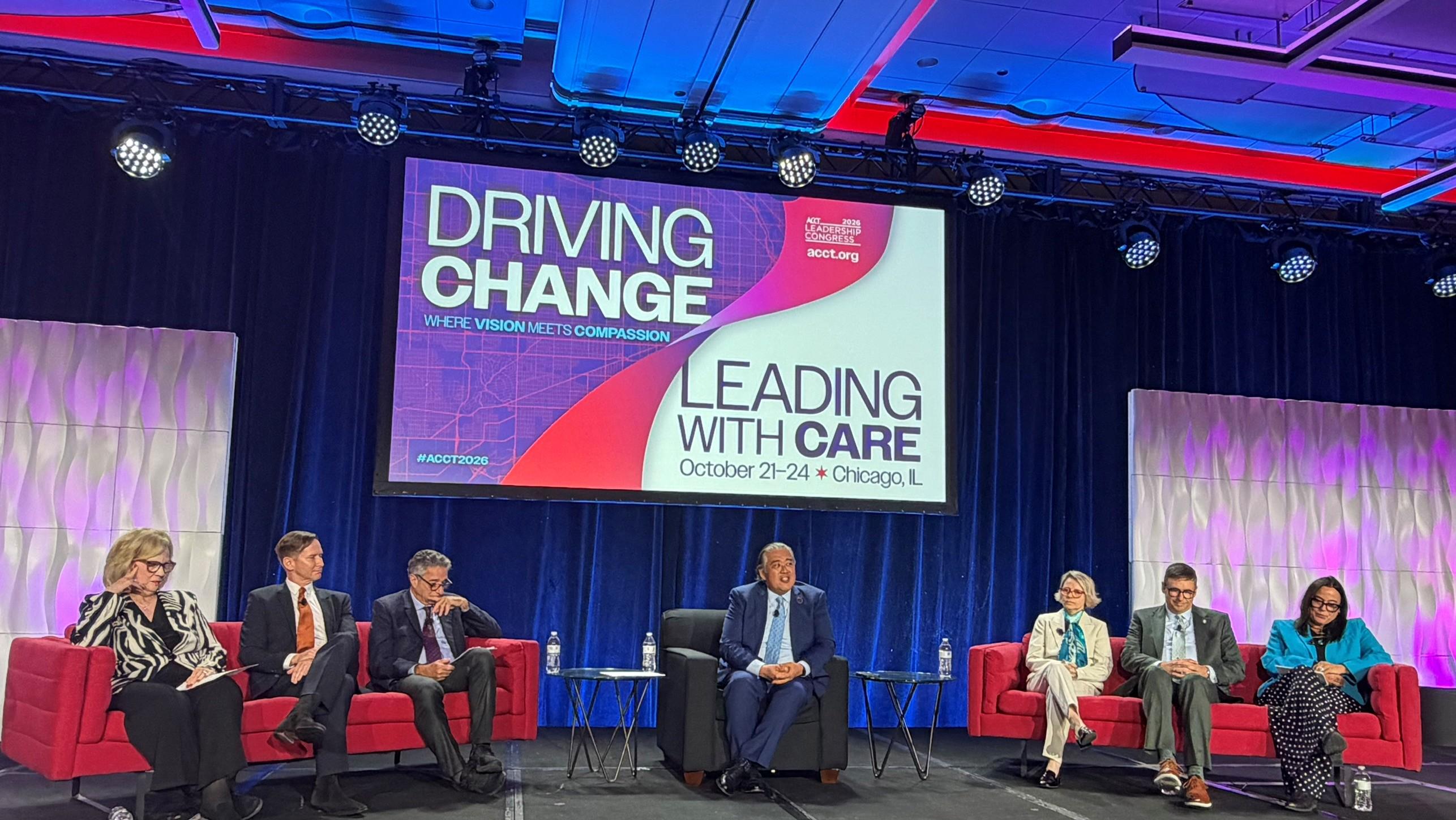
2026 Congress Day 1: 2026 Congress Kicks Off with Calls for Compassion Amid Change
The 2026 ACCT Leadership Congress kicked off in Chicago Wednesday night with a focus on wellbeing and support during a time of rapidly accelerating change.
“While we have a power within community colleges, our collective strength is not yet fully realized,” City Colleges of Chicago Chancellor Juan Salgado told attendees. “Over the next 10, 15, 20 years, there will be no more important institution of higher education to drive wellbeing all across this country than our community colleges.”
ACCT Chair Carol Del Carlo, Regent for the Nevada System of Higher Education, emphasized the event’s theme: Driving Change, Leading with Care: Where Vision Meets Compassion. “As governing board members, we are beholden to the mission, strategic values, and priorities of our colleges. That is why we must lead with care,” she said, stressing the value of supporting fellow board members, faculty and staff, and presidents and CEOs. “The CEO is usually the shock absorber, and no machine that works as hard as community colleges can afford to have their shock absorber break,” Del Carlo said. “Take care of your chancellors and presidents…. This is a two-way relationship. Care for one another.”
ACCT President and CEO Jee Hang Lee highlighted the association’s advocacy and education efforts, noting key achievements including the passage of Workforce Pell, the $840 million provided to community colleges following the return of congressionally directed spending, and the creation of new learning opportunities including ACCT Excel. “ACCT does a lot, but the one non-negotiable is that we’re here to support you,” Lee said.
Speakers highlighted the importance of rethinking institutions during an area of change driven by AI and other forces. “We are now moving at the speed of light,” N2N Services CEO Kiran Kodithala told attendees.
“Rethinking higher education is really hard work, and the leaders in this room aren’t waiting for the future to arrive. They’re shaping it every day,” said Cengage vice president Susan Walsh.
Change was echoed by the leaders of the six accreditation agencies which support the community college sector during a panel discussion. “You are the most important people in the college supporting the opportunity for change,” said Mac Powell, president of the Accrediting Commission for Community and Junior Colleges. “In a rapidly changing world, the status quo is not the answer.”
Noting the imminent changes to accreditation expected to be unveiled by the Trump Administration at the end of the month, speakers defended the independence of their organizations and urged community college leaders to focus on the “north star” of their mission.
“We are at a pivotal moment in the history of our country. The American higher education system is seen as the gold standard in the world because of the independence of our institutions,” Lawrence M. Schall, president of the New England Commission on Higher Education, told attendees. “As trustees, I encourage you to work very hard to keep your institutions independent and committed to your mission, and to see your accreditor as a partner in this effort.”
The anticipated entry of new accreditors will “force us all to look at ourselves differently,” said Selena M. Grace, president of the Northwest Commission on Colleges and Universities. “It challenges us as accreditors who have been here for so long to think differently about how we build and maintain relationships with colleges.”
Barbara Gellman-Danley, president of the Higher Learning Commission, stressed the importance of Workforce Pell and short-term credentials, calling them “an excellent way to get first-time learners, returning learners, and adult learners back into the system and lead them to success.”
Stephen Pruitt, president of the Commission on Colleges and Universities, discussed the challenges of finding labor market data to demonstrate the efficacy of short-term programs. He also called on college leaders to focus on broader measures of evidence than single data points. “Think about the evidence you need… to best support your students,” he said.
Heather F. Perfetti, president of the Middle States Commission on Higher Education, stressed the importance of trustee leadership through this period of change. “Accreditation is about institutional improvement. You all live it, you breathe it, and you drive it for your institutions,” she said.
Also on Monday, ACCT with New America's Future of Work & Innovation Economy initiative released a new research brief titled How Community College Trustees Can Bolster Economic Development. Drawing on a first-of-its-kind national survey of community college presidents and trustees, the brief finds that college leaders see economic development as central to their mission, but face barriers in fully realizing the impact of their institutions on state and local efforts to attract, retain, and improve the quality of jobs for the benefit of their students and communities. Learn more about the project.
The 2026 ACCT Leadership Congress continues today with workshops, sessions, and a presentation by keynote speaker Shaun Sperling.
Learn more about the 2026 ACCT Leadership Congress.