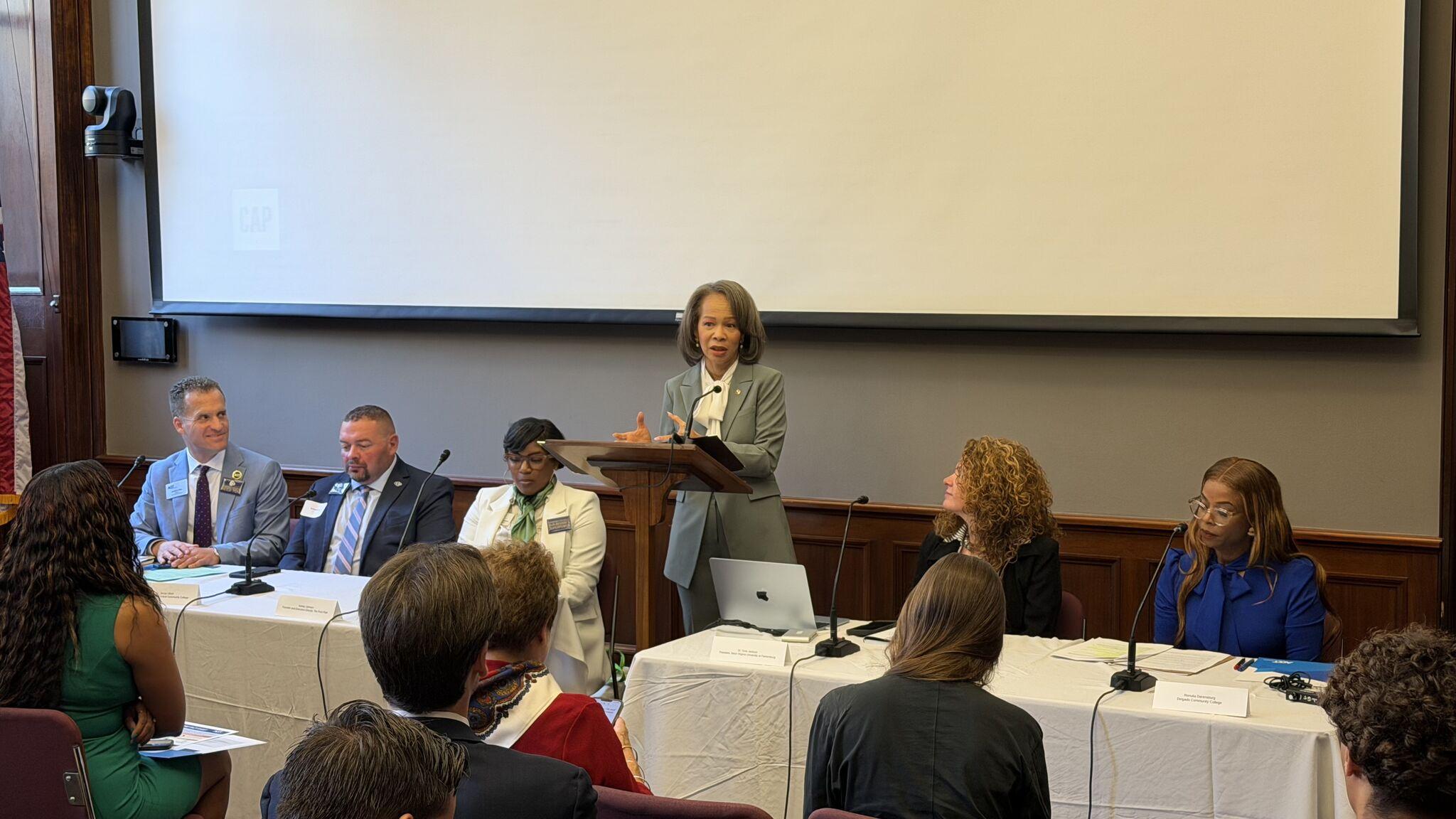
WASHINGTON, D.C.—September 17, 2026—Today, the Association of Community College Trustees (ACCT) in partnership with the Community College Coalition hosted the congressional briefing Strengthening America’s Workforce pipeline: The Role of Community College in Federal Education and Workforce Investments.
The event, convened at the Russell Senate Office Building on Capitol Hill, highlighted the essential role community colleges play in preparing workers, supporting local economies, and advancing domestic job creation. Speakers highlighted critical investments in student support and workforce pipeline programs to help students persist, complete credentials, and move into good jobs, with an emphasis on Pell Grants, Adult Basic Education, Child Care Access Means Parents in School (CCAMPIS), and Strengthening Community College Training Grants (SCCTG). The full event was livestreamed; a recording can be viewed here.
The event opened with remarks from Senator Lisa Blunt Rochester (D-Del.) and Senator Chuck Grassley (R-Iowa).
“We know we have workforce shortages, and community colleges are the ones that can fill them,” Senator Blunt Rochester said. “Community colleges provide an affordable economic opportunity. That’s why we have to make sure they have the resources they need—especially Pell Grants.”
In his video remarks, Senator Grassley said about the recently authorized Workforce Pell Grants, “I’m proud that my state of Iowa is leading the nation in putting that legislation to work. I supported the Workforce Pell and the Working Families Tax Cut Act. This was an important step in making Pell Grants work for more Americans. Before this legislation, you could only get a Pell Grant if you got a two-year degree or a four-year degree, so [Workforce] Pell helps open the door to higher education for millions of Americans who otherwise may not have been able to afford it. Workforce Pell builds on that legacy by recognizing that there’s more than one path to a good career.”
Iowa Central Community College is the first college to have been approved by its governor and the U.S. Department of Education for federal Workforce Pell Grants. College President Dr. Jesse Ulrich presented at this morning’s briefing, alongside West Virginia University at Parkersburg President Dr. Torie Jackson, Trenholm State Community College Adult Basic Education graduate Ashley Johnson, and Delgado Community College nursing student and Pell Grant recipient Ronulia Darensburg.
President Ulrich revealed that his father did not graduate from high school, and he lived in low-income housing across the street from his college when he was a student. He attended a community college with the support of Pell Grants, going on to graduate with a teaching degree, become a middle-school principal, a school superintendent, and then a college president by age 39. “But none of that would have happened without stacking up those opportunities from Pell Grants, subsidized and unsubsidized loans ... Work-Study," said President Ulrich. “When people come to Iowa Central, we want them to finish their degrees or certifications in as short a time as possible with the least amount of student debt so they can go on and live a better life. We understand that not every student needs a four-year degree to have a better life; at the same time, every student coming out of high school needs some type of training and certification or technical degree in order to have a better life.”
Jackson, another college president, worked during high school to support her family after her father lost his job, and she was only “able to go to college because of a Pell Grant. I decided when I saw my dad struggling [with only a seventh grade education] ... I decided in high school that education would be my path to something different," said President Jackson. "It could have been unattainable, but it wasn’t because I was able to be a Pell recipient, and I was actually able to graduate from college with almost no debt.” Jackson is paying it forward through offering similar opportunities at WVU Parkersburg. Thanks to a 2022 SCCTG award of $6.2 million from the U.S. Department of Labor, three West Virginia community colleges were able to enrich their nursing programs. “As a result,” Jackson said, “we’ve been able to increase our nursing students by 62.4 percent. That means we’re expanding the classes we offer from 24 to 48, we’ve been able to…have coaches for students, have more faculty, more adjuncts, increase our simulation hours, increase our clinical hours. We have a 100 percent pass rate for all our graduates whenever they do take their tests at the end. SCCTG allows you to take your program and be able to expand it.”
Johnson dropped out of high school in eleventh grade and attained her GED. “I know that people think people drop out for grades, but there’s several different reasons people drop out. Some are facing health issues, some take care of their families, some have behavioral issues,” said Ashley Jackson. While working toward her GED at her local community college, she was approached by a military recruiter, and after attaining her GED she enrolled in the Army and served 12 years. In addition to Department of Defense Tuition Assistance and on-base child care, the Pell Grant made it possible to complete her BA and MBA. After she got out, she created the GED-prep nonprofit organization The Pivot Path. “If it hadn’t been for the community college, I wouldn’t be here talking to you.”
Darensburg worked as a licensed practicing nurse (LPN) for 20 years and she had long aspired to earn her Registered Nurse certification. “However,” said Ronulia Darensburg, "my education often seemed financially and personally out of reach. Then, in 2021, my aunt became terminally ill with cancer. During her final days, she spoke to me about going back to school. She asked me to promise her that I will enroll at Delgado Community College and at least give myself the opportunity to try—because she was herself a Delgado grad. In the fall of 2021, I enrolled in my first night class. From there, I continued my education one night class at a time while working full time and raising my family. What once seemed impossible, slowly became a reality.”
ACCT Director of Public Policy Jonathan Elkin, who facilitated the event, pointed out that Darensburg’s college does not have a competitive CCAMPIS grant that offer on-campus child care. He asked her how child care support might have made her education easier. “If they did have that, it would have made a huge difference years ago, throughout those 20 years of child care at $160 a week. It would have been a difference maker for me.”
Elkin said that research shows low-income parenting students who are able to access CCAMPIS have triple the graduation rate of comparable students who don’t.
For more information: