
More than 2.5 million high school students take dual enrollment courses each year — earning college credit while in high school, which lowers costs, accelerates time to degree, and builds confidence in postsecondary success.
At least 200 bills focused on dual enrollment and dual credit have been introduced in 45 states, but participation still varies widely from state to state. And while dual enrollment students of all backgrounds earn higher grades and enter and complete college at higher rates, economically disadvantaged, first-generation, and rural students are significantly less likely to have access to dual enrollment programs.
To help community college trustees and leaders understand and advocate for policies and practices that better support and fund dual enrollment, ACCT explored innovative state strategies for community college funding and dual enrollment in Texas and California.
PROJECT NEED
Increasingly, community colleges are called on to serve three distinct purposes within their community: the traditional role of associate’s degree/transfer student educator, and the increasing roles of high school educator via dual enrollment and workforce training provider. As pathways to careers continue to both morph and meld, the latter two roles have become increasingly important but have not always received the equal weight of funding and prioritization needed, particularly at the state level, to support this work.
ACCT has launched a new project exploring innovative state strategies for community college funding and dual enrollment in the states of Texas and California. This initiative explores two states that are prioritizing dual enrollment and pathways learning as part of their funding models.
The initiative builds upon ACCT’s existing work analyzing nationwide funding strategies for community colleges. The new project will focus specifically on Texas’s new community college funding formula and California’s dual enrollment initiatives.
OVERVIEW
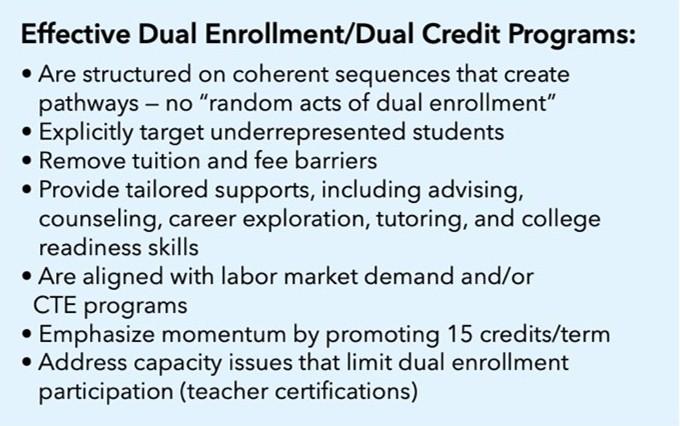
• One-Pager: Why Dual Enrollment Matters
• Article: Lessons Learned from Dual Enrollment: The Trustee Role
• Presentation: Overview of Dual Credit/Dual Enrollment Research and Policy Options
• In the Know With ACCT Podcast: State-Level Approaches to Dual Enrollment: California and Texas
• Blog Post: Scaling Up Dual Enrollment
• Blog Post: First Resource from Pathways Exploration Work to be Released at the National Legislative Summit
PRE-CONFERENCE SESSION: SLIDE DECK
STATE-SPECIFIC RESEARCH
TEXAS
Texas adopted an outcomes-based funding formula for community colleges in 2023.
CALIFORNIA
California has invested in dual enrollment pathways through multiple funding streams, emphasizing closing equity gaps and aligning programs to regional employment needs.
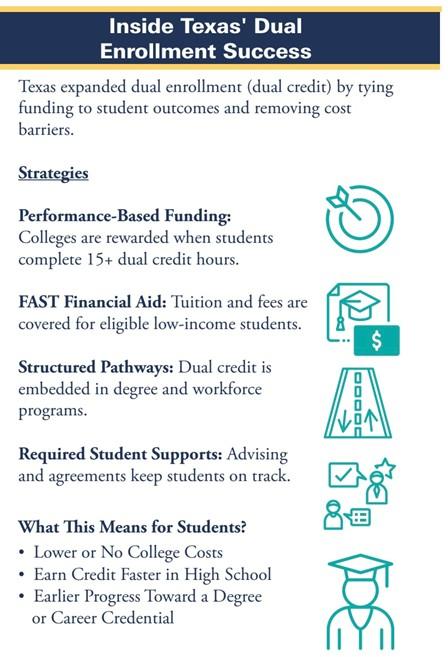
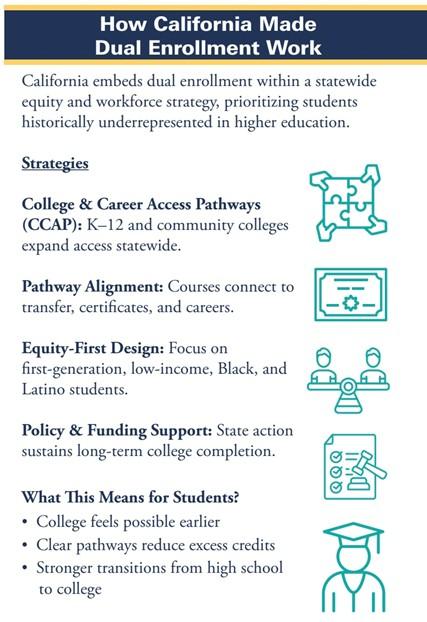
Report:
• Building a Bridge to Opportunity: The Rise of Dual Credit Pathways in Texas
Webinar:
• The Rise of Dual Credit Pathways in Texas
Blog Post:
• Exploring the New Community College Funding Model in Texas
• First Resource from Pathways Exploration Work to be Released at the National Legislative Summit
In the Know With ACCT Podcast:
• Navigating Dual Enrollment: The HB 8 Texas Rollout
Background:
• Texas House Bill 8: Overview
Webinar:
• California's Bridge to Opportunity: Investments in Dual Credit Pathways
Blog Post:
• California Making Strides to Spread Dual Enrollment to All High School Students
In the Know With ACCT Podcast:
• Key Insights from California's Dual Enrollment Strategy
ADDITIONAL RESOURCES ON DUAL ENROLLMENT
- Dual Enrollment Boosts College Success But Gaps Remain, Community College Research Center, 2024
- Student Engagement Research, Giani et al., 2023
- Listening to Learners, Tyton Partners, 2025
- Should Students Falling Behind in School Take Dual Enrollment Courses?, Journal of Education for Students Placed at Risk (JESPAR), Taylor & Francis Online, 2022
- Dual Enrollment Equity Pathways Report, Community College Research Center (2022)
- Scaling Dual Enrollment in Rural Communities, Community College Research Center (2023)
- Dual Enrollment Participation Data Report, National Student Clearinghouse Research Center (2024)
- Research Priorities for Equitable Dual Enrollment, College in High School Alliance (2023)